A Rod & Staff Media film · in production

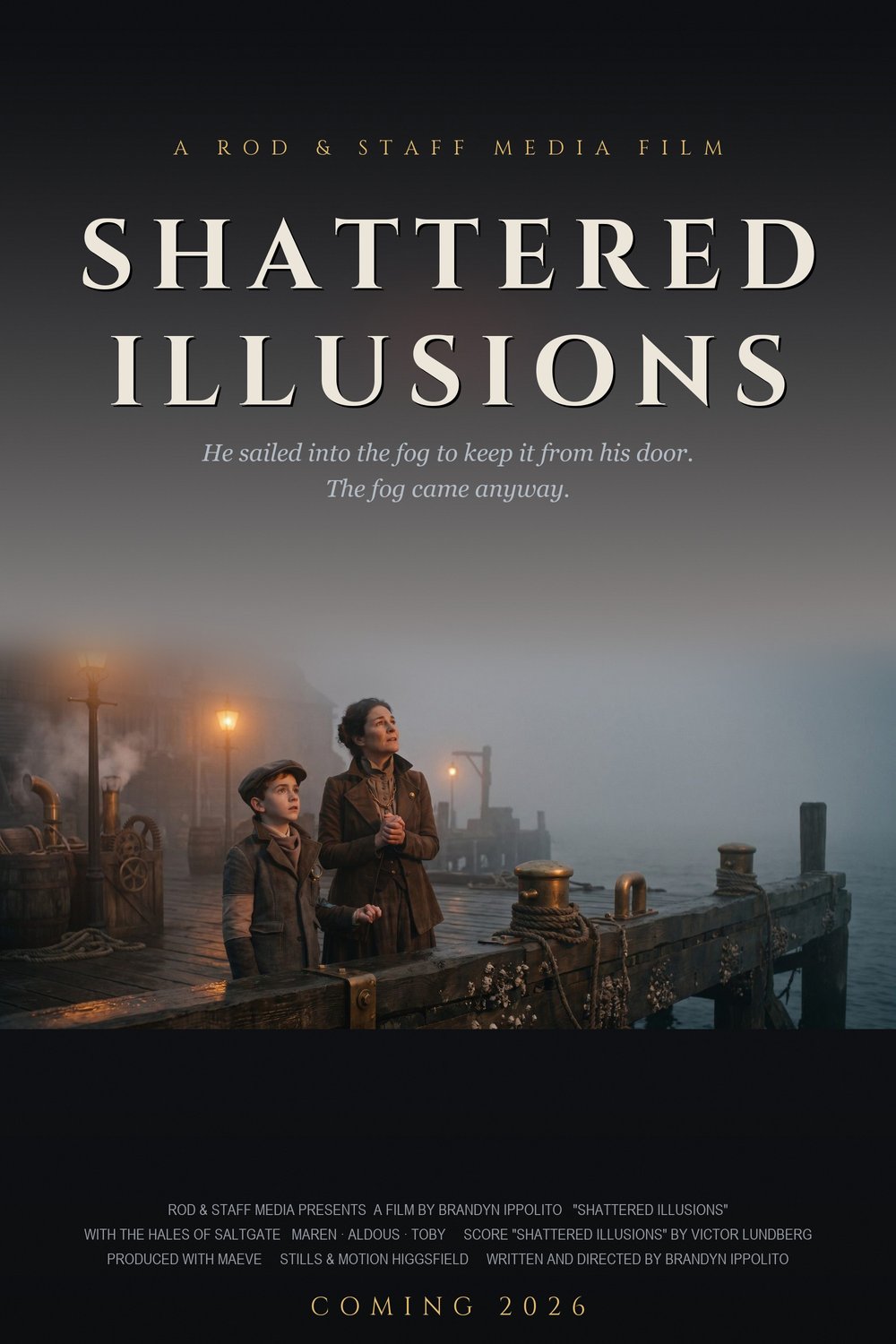
SHATTERED
ILLUSIONS

A wife and her son wait at the edge of the sea while their man sails with the fleet into a battle that cannot be won — and when the guns finally fall silent, the cruelest thing the sea sends back is nothing at all.

Format Trailer · 3:44 · 21:9 World Steampunk fantasy Score “Shattered Illusions” — Victor Lundberg Started Aug 21, 2026
01 · The music came first

The track is the script

Nothing in this film was written and then scored. The piece of music was chosen first, measured second, and only then was a story allowed to exist — and only if it survived a full listen with eyes closed.

That rule came from a film that failed. The one before this had a story written before the music was truly heard; the more the track played, the further the ideas drifted from it, until it was vetoed in a sentence. So the house pipeline now runs in order — track → notes → story → beats → style → storyboard — and every step has a gate: the story has to match the music on a complete play-through before anything gets drawn.

The track’s loudness was measured with an audio analysis tool to find its real shape: where it emerges, where it holds, where it collapses, and the single loudest instant of the piece. The story was then built to land on those moments rather than near them.

“I just listened to it three times. It survives for sure.”Brandyn — the full-listen gate, Aug 21, 2:24 PM

The measured arc

0:00 1:05 2:00 2:30 3:25 3:44 EMERGE THE BED FIRST SUMMIT COLLAPSE THE ASCENT ABSOLUTE PEAK −9.6 LUFS SHATTER

Loudness measured with ffmpeg (EBU R128); curve simplified for the page. The track does not end in triumph — it peaks at 3:25 and falls to silence in fifteen seconds. The illusion is most magnificent the instant before it breaks.

TimeMovementWhat it does
0:00–0:20EmergenceFrom silence to a quiet bed
0:20–1:05The bedSteady plateau, holding
1:05–1:55First ascentA real build to a first summit
2:00–2:10The collapseThe floor drops
2:10–2:30RegatheringClimbs, wavers, climbs
2:30–3:25The relentless ascentOne unbroken climb
3:25Absolute peakThe loudest instant of the piece
3:25–3:44The shatter−28 LU collapse to silence
02 · The story

The ones who wait

Fog. A woman — dressed well, but dirty, like someone keeping standards through hard times — stands looking out to sea, longing. Her boy joins her, hopeful and scared in the same breath.

Elsewhere, men who are wartorn and stoic ready their ships: cannons loaded, boilers stoked, steam driven into engines — the quiet before facing an enemy they know outguns them. Then the world rushes — waves and clouds streaming past, time itself fast-forwarding — and we are in it: a naval battle heard as if underwater, a dream of fire. The enemy bears down without mercy. Friendly ships burn and go under. Men are thrown into the sea.

At the height of it — the loudest instant of the track — the man himself is blown into the water, floating, left for dead. And as the music shatters, the camera flees back across the sea to the shore: the woman and the boy, praying through the fog for their father and husband to come home.

We never learn what happened to him.

The whole story was dictated in one pass on the afternoon of August 21 while the track played, then written down verbatim before a single image was made. The ending feeling, in the director’s words: agony and longing. Not knowing.

The woman and the boy at the fog-wrapped dock at the end of dusk, her hands clasped, both faces lifted toward the sea.
Approved frameThe final image. The shore at the end of dusk — the last warmth left in the world, and it’s fading.
The Captain floating on his back in black night water, his face lit by distant fire through the fog.
Approved frame3:25 — the film’s single image. The loudest instant of the music belongs to one silent man in the water.
03 · The beats

The story cut against the clock

Nine beats, each pinned to a measured moment in the track. The director’s first telling already matched the music’s shape almost beat for beat — the collapse and the peak landed exactly where his instinct put them.

  1. 0:00–0:20
    Emergence — the low violin hum
    The shore, the woman

    Low angles through fog and cloud. A woman, well-dressed but dirty, looking into the distance — longing.

  2. 0:20–1:05
    The bed — steady, holding
    The boy

    He comes into view beside her, peering out — hopeful and scared. Long establishing holds: who they are, what their situation is.

  3. 1:05–1:55
    First ascent
    The preparation

    The fleet: wartorn, stoic men loading cannons, driving steam into engines — anticipation of an enemy they know is overwhelming. Closeups of resolve.

  4. 2:00–2:10
    The collapse — the floor drops
    The rush

    Waves and clouds streaming past, fast-forward motion — the world shifts.

  5. 2:10–2:30
    Regathering — low, uneasy
    The dream-battle begins

    The camera lands inside a raging naval battle — but muted, dreamlike; the guns flash and you barely hear them.

  6. 2:30–3:25
    The relentless ascent
    The battle full

    Sound and fury arrive together: enemies firing without mercy, fires erupting, friendly ships going down, men thrown into the sea. Character closeups cut against the enemy barreling down.

  7. 3:25
    Absolute peak
    The man

    The Captain is thrown into the water — floating, left for dead. The film’s single image.

  8. 3:25–3:40
    The shatter — collapse begins
    The shore again

    One fleeing move back across the sea through cloud and fog to the dock’s edge: close on the woman and the boy, praying. Faces only.

  9. 3:40–3:44
    The last seconds to silence
    The dissolve + title

    One slow pull-back into the fog — as the camera enters it, they slowly disappear. Silence. SHATTERED ILLUSIONS rises.

Cutting rules: beats 1–3 are long holds; beat 4 is the only fast camera in the first half; beat 6 cuts accelerate with the music; beat 8 is one single fleeing move and then stillness. The battle’s sound lags the picture until beat 6 — the dream rule.

04 · The world

Steam won

“The turn of the industrial revolution, in a fantasy world where the steampunk idea survives.” Not a real decade — a world that grew from steam having won. Every frame obeys a short list of laws that were written one red-pen verdict at a time.

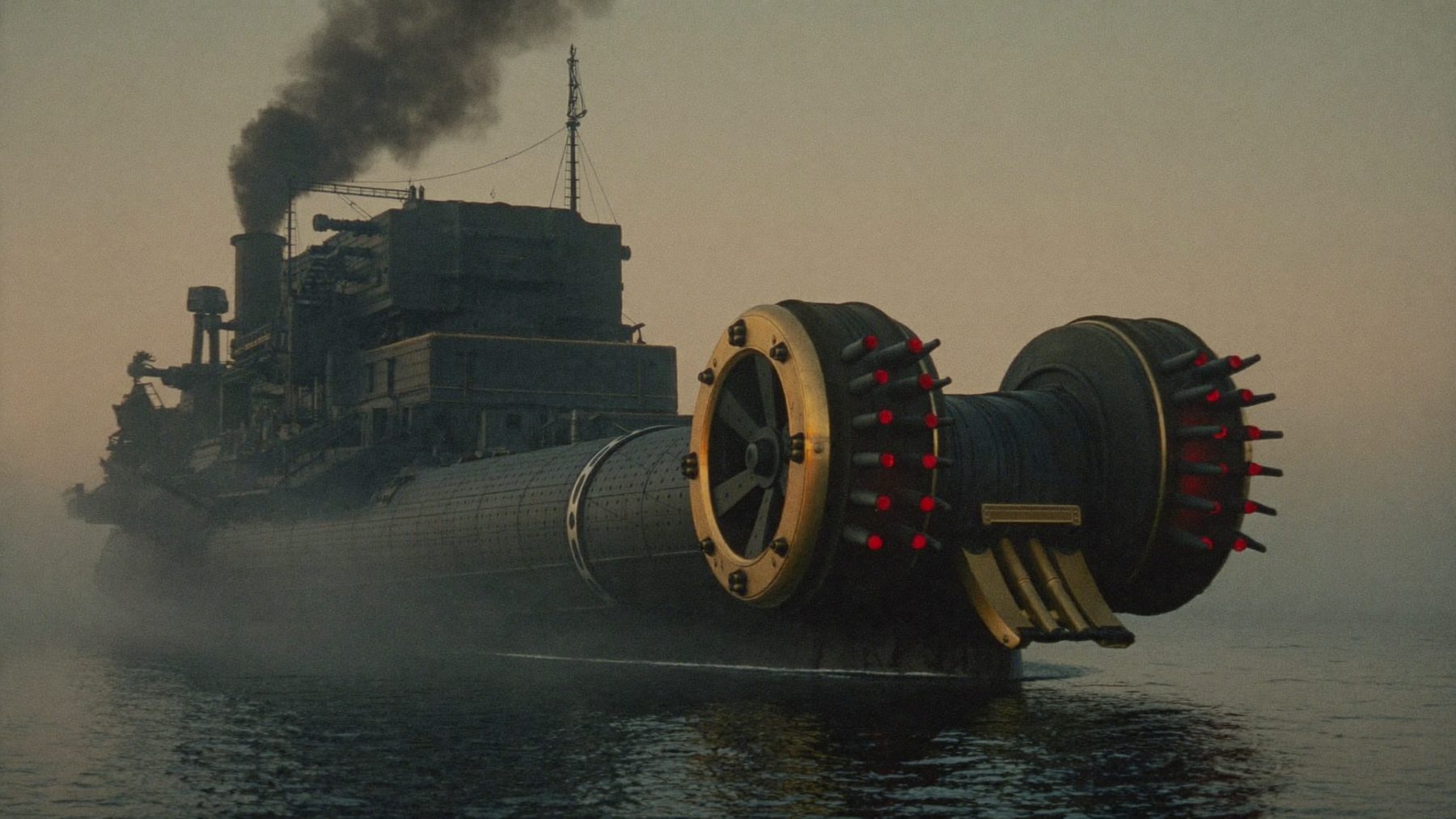
The leviathan war-machine emerging bow-first from a wall of sea fog, rows of red furnace glow.
CanonThe Leviathan. The enemy is a few colossal engines against our many — never humanized. Bow-first from the fog wall, rows of red glow.
A copper-ribbed airship escort with a brass gondola in light fog.
CanonAirship escort. The battle happens in two layers, sky and sea.
A brass ironclad warship in side profile on calm gray water.
Fleet DNABrass ironclad. Paddle-gear, twin stacks, amber portholes — ours.
A weathered harbor dock at dusk with gas lamps just lit, cranes and masts in fog.
LocationThe harbor dock-town edge. Where the film opens and closes.
The lantern-lit gun deck of a brass ironclad lined with ornate cannons.
LocationThe gun deck. The preparation happens here.
Glass-calm gray water stretching into a wall of heavy sea fog.
LocationThe open sea fog-field. Eerie calm — the terror is in the stillness.
A foggy harbor corner with one lit lamp against a dusk sky — the warm grade reference.
Grade plateWarm pole. Amber through harbor fog — home.
Dense gray sea fog lit from within by distant fire blooms — the cold grade reference.
Grade plateCold pole. Fire blooming soft through the murk — war.
Sailors in navy-brown wool greatcoats working cannon drill in lantern light.
CanonThe crew. The Captain’s uniform family — brown wool, brass buttons, peaked caps. Took three rounds to get the navy disciplined.
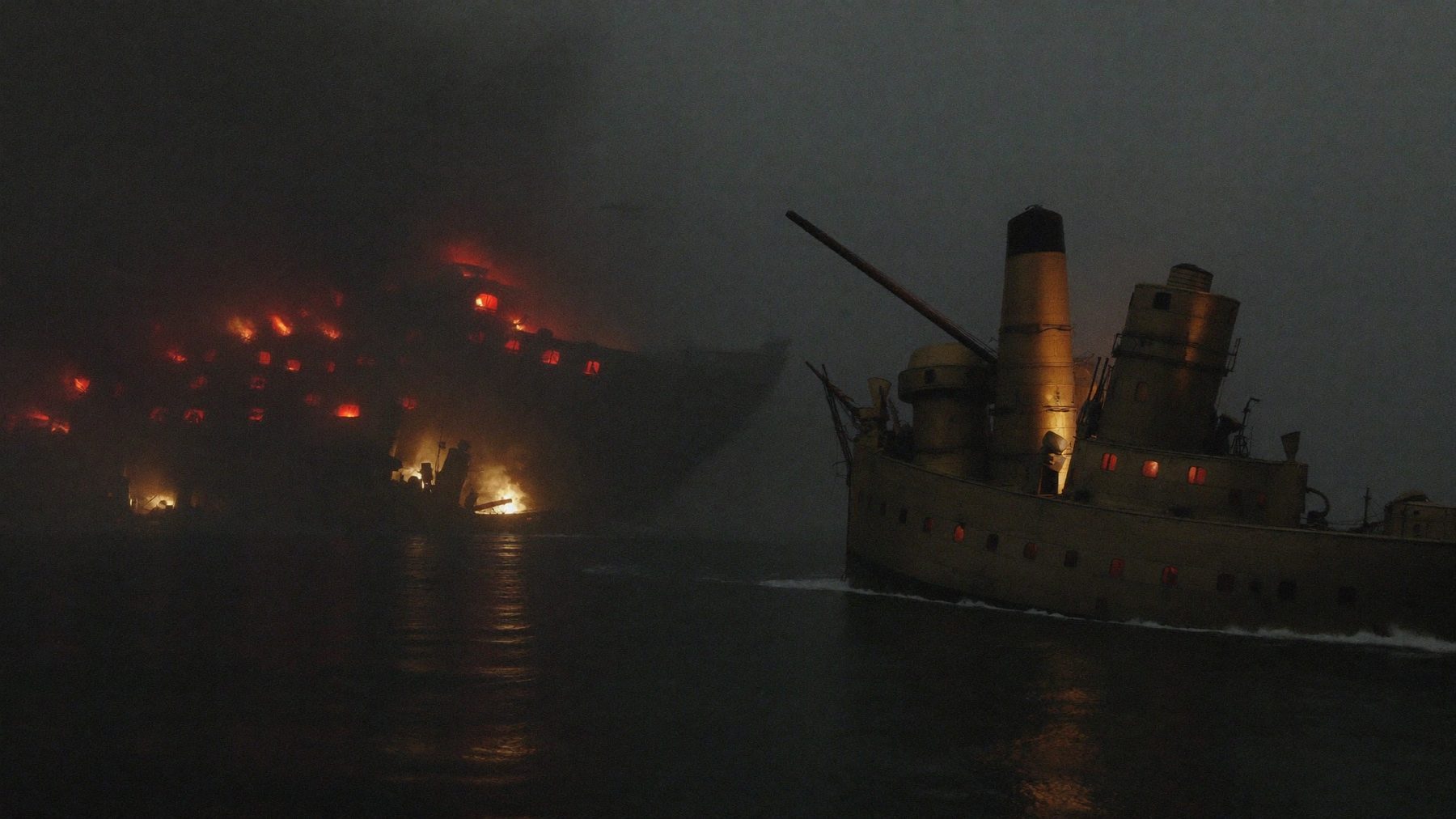
Night naval battle in heavy fog: a warm-lit gunboat in the foreground, the red-glowing leviathan mass behind.
Design authorityThe night battle. This single frame settled the fleet: the good-guy gunboat in the foreground, the leviathan as a red-row mass in the fog behind it. Every battle shot since has been pinned to these two designs.
“I want it all to be darker and closer to night than just dusk. Maybe the end of dusk.”The darkness ruling — Aug 21, 8:03 PM
05 · The cast

How the people were made

Nobody in this film was cast from a costume rack. The leads came out of the story — and out of a long morning of being told “no.”

1. Calibrating the look. Before there was a story there was a style hunt: dozens of frames in batches of two and three, compared side by side, with the director circling what worked and crossing out what didn’t. Fourteen reference photos set the bar. Early lanes died fast — anything that read as animation, anything with automatons, anything “not steampunk enough.” What survived was a couture lane: photoreal portraits, single warm key light, encrusted period detail, real skin.

“I do want photorealistic — not animated.”The clarifying note that killed half the candidates

2. Character cards. With the story written, each lead was generated as a three-quarter portrait on a neutral fog-gray backdrop — a casting card, not a scene. The Captain’s first take grinned and was rejected on sight (“never”); the Boy was recast twice before his face arrived; the Woman landed on the first deck.

3. Minting identities. The three approved cards were turned into reusable character elements — a locked identity that can be dropped into any scene, alone or together, and hold its face. That choice (elements over training a single-person model) is what lets the woman and the boy share a frame.

4. The proof. The first composed scene put both of them at the dock together. The verdict was four words — “The woman and boy are good” — and every frame since has been built on that pipeline.

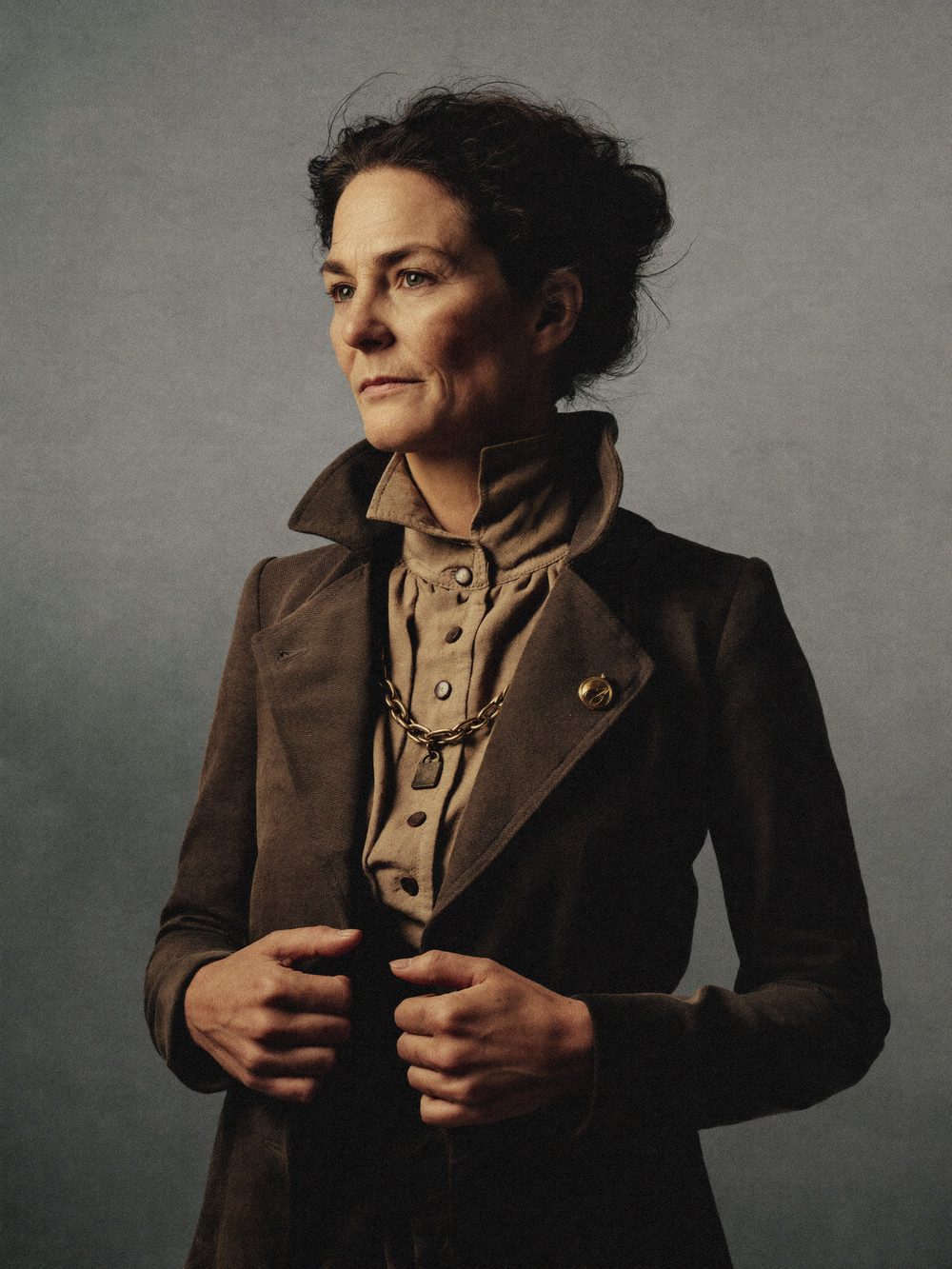
Character card: the Woman, three-quarter portrait, once-fine wool coat kept with dignity.
The Woman. Dressed well but dirty — keeping standards through hard times. Womanly and proper, rough and tough.
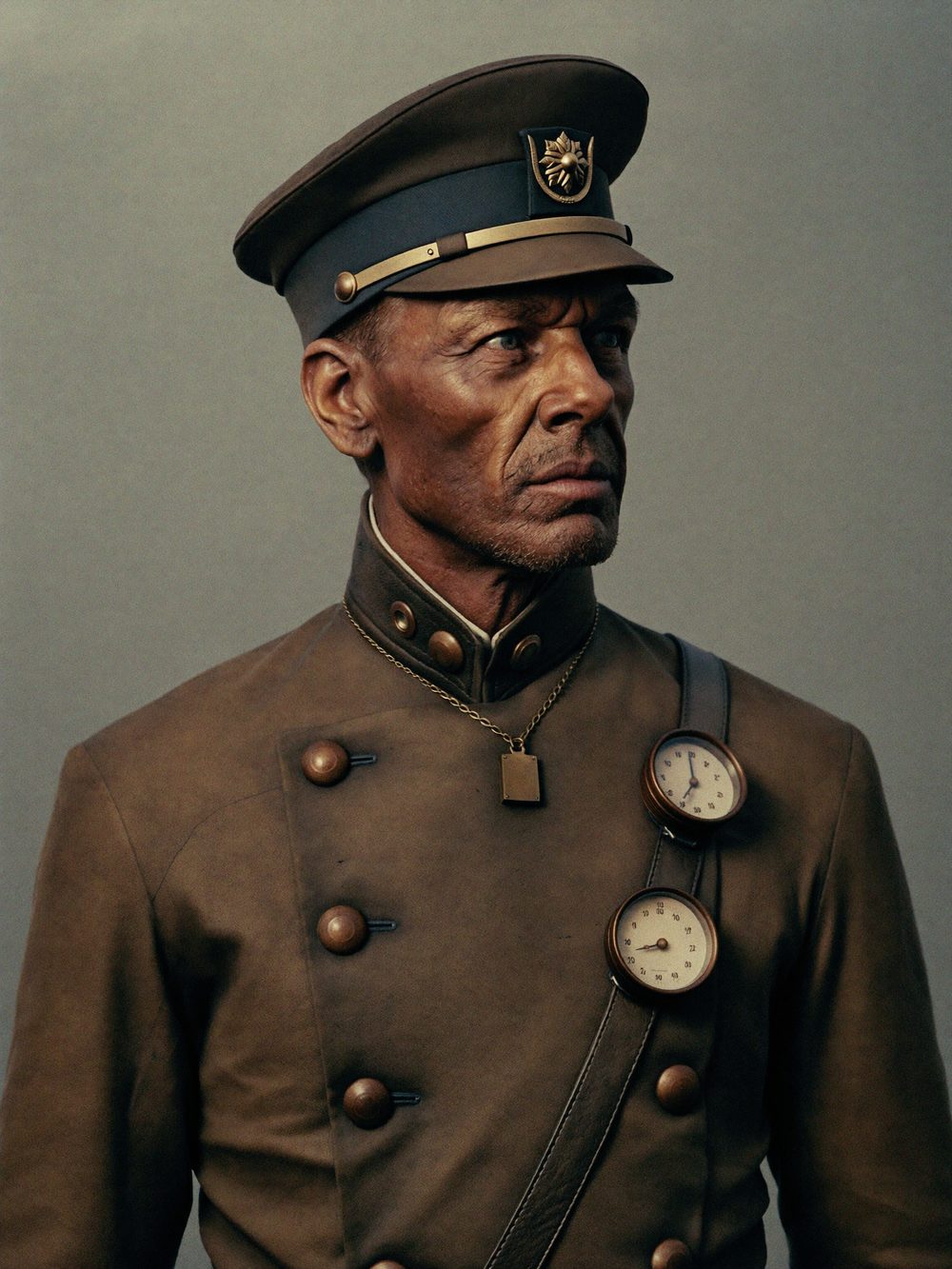
Character card: the Captain, weathered navy greatcoat with brass buttons and gauges, peaked cap.
The Captain. Father and husband. Wartorn, stoic, strong — dignity over exhaustion.
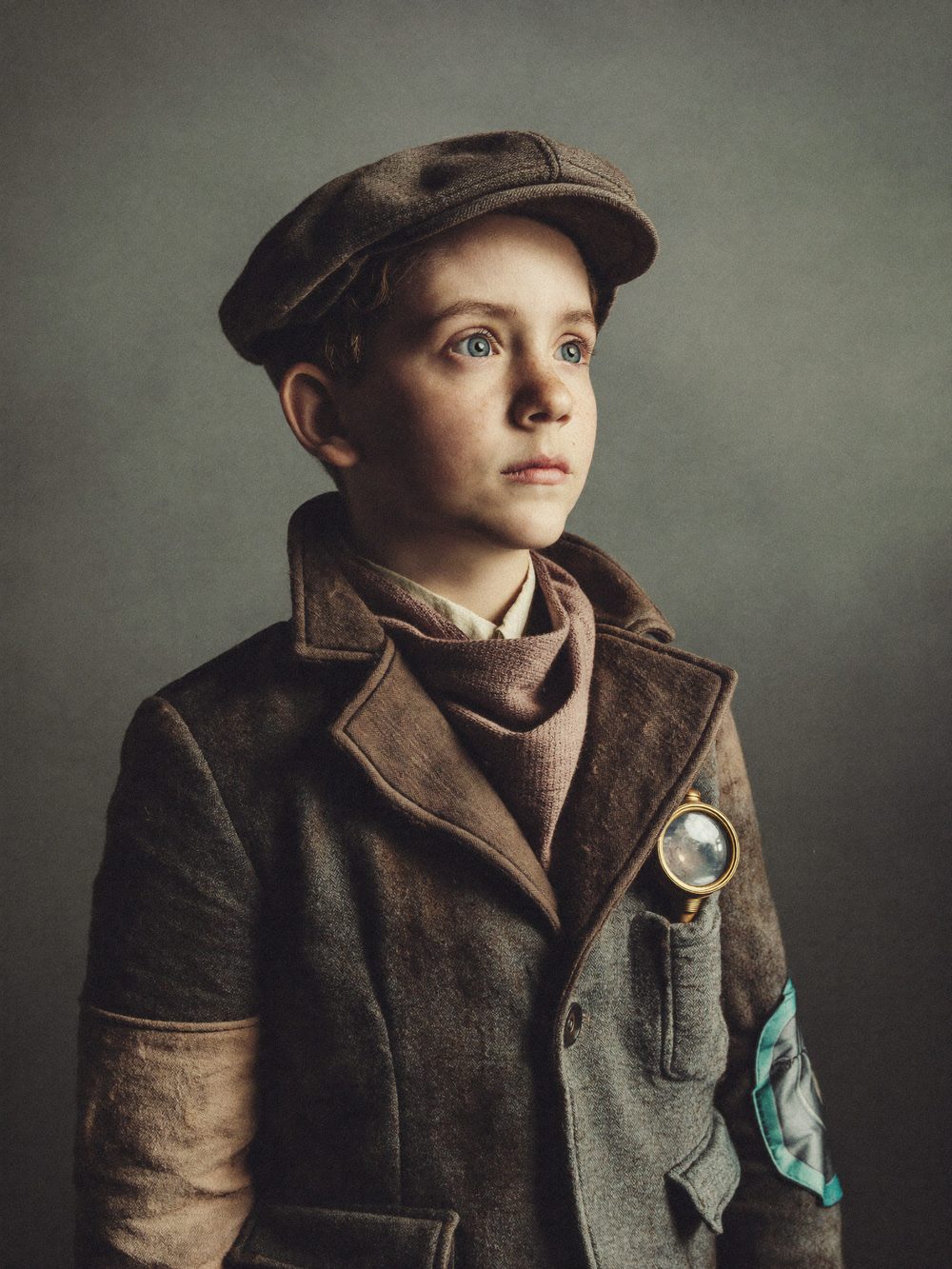
Character card: the Boy, ten to twelve, patched wool coat and flat cap.
The Boy. Ten to twelve — old enough to know exactly what the smoke means.
The Woman and the Boy together at the fog-wrapped dock at dying dusk — the first composed scene.
Pipeline testThe first scene with both leads. Identities held. “The woman and boy are good.”

The Captain’s frames — and the red pen

Every still is approved before it is allowed to move. The Captain’s first round produced three; the director’s markup produced two new laws in one sentence each.

The Captain close, turned over his shoulder toward the stern as his ship leaves harbor; the dock lamps distant glows in fog.
ApprovedThe last look home. The longing he will not show his men. Ties him to the shore without ever showing it.
The Captain close at the brass rail, looking toward a red glow in the fog.
ApprovedAt the rail. The enemy is nothing but a red glow in the fog. First version had him staring past camera — “shouldn’t the captain be looking at the ship attacking him?” Fixed: he looks at what is trying to kill him.
Inside the wheelhouse, over the Captain's shoulder: his hand on a brass lever, the red glow through fogged glass, the helmsman a silhouette.
ApprovedThe bridge. The red glow through the condensation; the helmsman only a shape.
The Captain at a ship's wheel and telegraph on an open deck — the rejected frame.
CutThe wheel. Rejected twice over: the controls were on the open deck (“typically the controls for the ship are in the bridge”) and the telegraph dial kept growing lettering. Two laws for the price of one frame.
“The faces need more feeling — more intensity by showing less. More fog of war and mystery. We want everyone to know there is a battle, but I don’t want them to know all the details. I want them to have to use their imagination some too.”The restraint law — Aug 21, 8:41 PM. It governs everything, including motion.
06 · The method

Fog is the film

Moving a still is easy. Moving it a little turned out to be the whole problem.

The first motion takes swung the fog across its entire range in six seconds — a shot would open swallowed and clear completely, or open readable and drown. Describing the fog in words (“roll in,” “thin out,” “slightly”) was the wrong tool: the model obliged every adjective to the extreme, and it treated the approved still as a reference rather than a locked first frame.

Bounded fog. The fix was to stop describing and start pinning. Each shot is now given a start frame and an end frame — the approved still, and an edited copy of that exact still with only the mist changed. The motion can’t swing past what the two pictures allow, and the end frame holds the faces at the close as well.

The ladder. The first bounded pass was so narrow the takes were indistinguishable (“all four look the same to me”). So the end frames were cut at visible rungs — noticeable, heavy, swallowed — and clips were rendered between rungs in both directions. The director picks the width per beat, by eye.

Direction is an edit decision. Whether fog rolls in or rolls out isn’t a law — it depends on where the clip lives. The same dock opens the film with fog rolling out as the world emerges, and closes it with fog rolling in as the family disappears.

“The fog in both of these can either come in or roll out — it all depends on how we’re going to use the clips.”Correcting a law that had been written the wrong way round

The fog ladder

Same approved frame, mist stepped up in rungs. Clips travel between any two.

The shore still at its approved fog level.
Original — approved
The same frame with noticeably thicker fog.
+40 — noticeable
The same frame with heavy fog, figures half-seen.
+70 — heavy
The same frame swallowed by fog, ghost silhouettes only.
Swallowed — the end state

The Captain’s band is the red glow

For him the end frames don’t just add fog — the enemy comes closer.

Rail, start frame

Start

Rail, end frame with the red glow larger and closer

End

Bridge, start frame

Start

Bridge, end frame with the red glow filling the glass

End

Last look, start frame

Start

Last look, end frame with the harbor gone to fog

End — home is gone

07 · Footage

What moves so far

Six-second shots, silent by design — the track owns the sound. Two are locked; the Captain’s three and the dissolve are awaiting the director’s mark.

LockedThe shore — fog rolls out. Opens fogged; the two of them emerge as the mist thins. The film’s opening direction.
LockedThe battle — fog rolls in. The gunboat and the leviathan’s red rows, taken by the murk until only the glows survive. “That is the one for the boat. Nailed it.”
Awaiting markThe Captain at the rail. The red glow swells closer until it’s on the brass and the edge of his face. He does not blink.
Awaiting markThe bridge. The glow fills the fogged glass; the helmsman eases the wheel; the Captain pushes the lever forward one notch.
Awaiting markThe last look home. He watches the harbor lamps die behind him, then turns to face the bow.
Beat 9 testThe dissolve. A slow pull-back as the fog takes them — the first attempt at the final shot, exactly as the director designed it.
08 · Production log

Two days, so far

Still to shoot

The preparation (gun crews and boilers as shapes in the steam) · the rush transition at 2:00 · the 3:25 man in the water, in motion · then the assembly against the track, where the cut finally meets the music it came from.